Singapore projects need tiles that balance design, safety and long-term performance. This applies to homes, hotels, shops, offices and public spaces. Yet choosing tiles involves more than comparing colours and factory prices.
Buyers should review the tile material, water absorption, slip resistance, wear rating and dimensional tolerance. Batch consistency, export packaging and customs documents also matter. An experienced Indian wall and floor tile exporter can support project-scale sourcing, but every product should still be checked against the intended use.
This guide explains how to assess materials, finishes, technical data, packaging and import planning when choosing a wall and floor tiles exporter to Singapore.
Why Source Wall and Floor Tiles from India?
Product variety for different Singapore projects
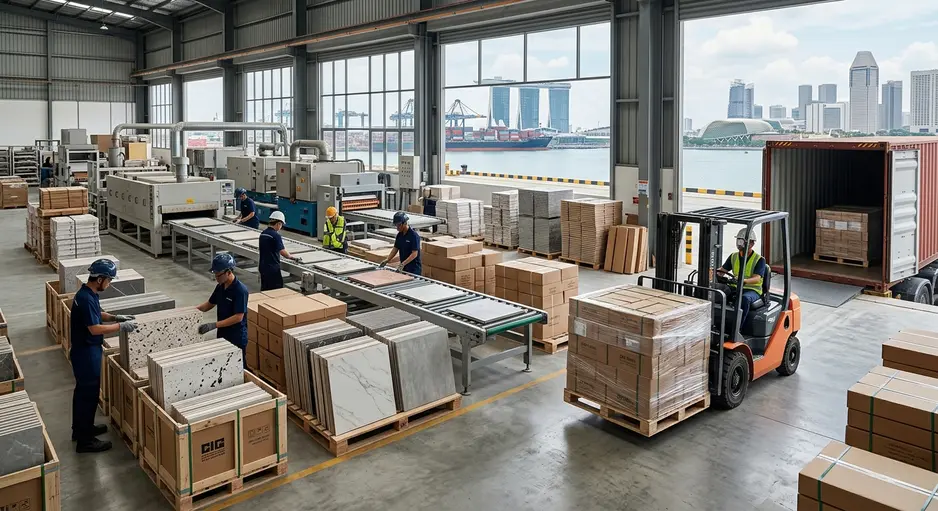
Indian manufacturers can offer ceramic and porcelain tile materials for a range of interior and exterior uses. Available choices may include glazed and unglazed surface options, along with polished, satin, textured and matte finishes.
Buyers can also explore stone, marble, concrete, wood and decorative looks. Standard formats work well in compact rooms, while large-format tile dimensions can create fewer visual breaks in open spaces.
Do not select a tile by design alone. Ask whether the quoted series, size and finish are approved for the intended wall, floor, indoor or outdoor application.
Supply for residential and commercial requirements
Wall and floor tiles for residential projects may be used in apartments, condominiums and landed homes. Commercial buyers may need wall and floor tiles for hotels and offices, retail units, restaurants or other busy areas.
A commercial tile exporter to Singapore may also help with repeat orders or phased developments. However, repeat production can have small shade or calibre differences. Buyers should discuss batch planning before confirming the order.
Ceramic or Porcelain: Which Tile Should You Choose?
Understanding ceramic and porcelain tile materials
Tile body composition, pressing and firing affect strength and absorption. Porcelain is usually denser and less absorbent than many standard ceramic products. This can make it useful for floors, wet spaces and demanding areas when the surface also meets the project specification.
Ceramic tiles remain practical for many interior walls. They can be easier to handle and cut, which is helpful around corners, fittings and service points. “Ceramic” is also a broad product category, so buyers should confirm the declared classification instead of relying on a product name.
What does water absorption classification mean?
Water absorption shows how much water the tile body takes in during a defined test. ISO 13006 and EN 14411 are commonly used to classify ceramic tiles. Porcelain tiles are generally classified at 0.5% water absorption or below.
Low absorption can be important in wet or exposed areas. Still, it does not prove that a tile is slip resistant, stain resistant or suitable outdoors. Each performance feature must be checked separately.
Glazed and unglazed surface options
Glazed tiles provide broad design choices and are often easy to clean. Unglazed or through-body products may make surface wear less visible in some busy areas. The best choice depends on traffic, cleaning methods and exposure.
Matching Tile Specifications to Each Application
Bathroom and kitchen wall applications
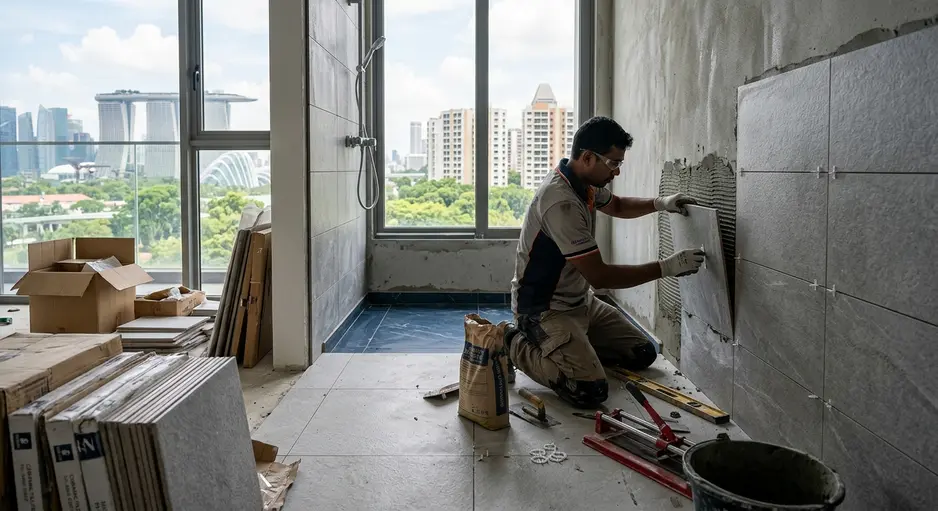
Bathroom and kitchen wall applications need surfaces that are easy to clean. Stain and chemical resistance may also matter where cleaners, cooking oils or personal care products are used.
Tile size should suit niches, corners, outlets and drainage layouts. Large tiles can reduce grout lines, but small formats may be easier to fit around slopes and tight details. Check whether a product is wall-rated, floor-rated or suitable for both.
How does slip resistance protect wet areas?
Slip resistance for wet areas is important in bathrooms, washrooms, entrances and other places exposed to water. A polished finish may suit a dry feature wall or office lobby, but it may not provide the grip required on a wet floor.
Structured and matte surfaces often provide more texture. However, appearance is not proof of performance. Buyers should request test information and confirm the required method and rating under the applicable Singapore or project specification.
Abrasion and wear resistance for busy spaces
Hotel corridors, retail areas, office floors and lift lobbies receive regular foot traffic. Abrasion and wear resistance help show whether the surface can retain its appearance under expected use.
Glazed-surface abrasion and deep-abrasion results apply to different tile types. Ask the floor tiles manufacturer to explain which test covers the quoted product and how it relates to the intended traffic level.
Is a tile suitable for outdoor paving?
Outdoor paving suitability depends on more than low water absorption. Wet-weather grip, drainage, substrate design, staining, heat and movement must all be considered. Exterior use should be confirmed in writing by the supplier and project consultant.
For example, a polished large-format porcelain tile may suit a dry office lobby. A textured matte tile with verified wet-area performance may be better for a sheltered entrance. Coordinated designs do not need identical surface specifications.
Tile Sizes, Edges, Finishes and Visual Consistency
Rectified tile edge specifications
Rectified tiles are mechanically finished to create more consistent edges and dimensions. They can support neat, visually narrower grout joints when the substrate and installation quality are suitable.
Rectified does not mean grout-free. Grout joints remain important for installation tolerance and movement. The installer should follow the approved layout, adhesive guidance and joint requirements.
Planning with large-format tile dimensions
Large tiles can give walls and floors a clean, continuous look. They also need careful handling, suitable cutting tools and a flat substrate. Correct adhesives, levelling systems and movement joints may be required.
Confirm both nominal and actual dimensions. Buyers should also review thickness, dimensional tolerance and carton weight before planning transport or installation.
Colour and pattern consistency between batches
Colour and pattern consistency can vary slightly between production runs. Check the shade, calibre, pattern variation and number of available faces. Random-face designs should be dry-laid before installation so the pattern can be balanced.
Approve a physical or “golden” sample and record the product code, finish, shade, calibre and batch on the purchase order. Keep replacement tiles from the same batch where possible.
How to Evaluate a Tile Manufacturer or Exporter
Questions to ask a wall and floor tile supplier
Clear questions make quotations easier to compare. Ask each potential supplier:
- Which formats, thicknesses and finishes are available?
- What is the minimum order quantity for each model?
- Can different designs be consolidated in one container?
- Are relevant product test reports available?
- How are shade and calibre controlled?
- What are the production and dispatch lead times?
- How are shortages, complaints and transit damage managed?
Documents to request before ordering
A complete order file should include the product specification sheet, relevant ISO 10545 test reports, commercial quotation and agreed Incoterms. Buyers should also request packing details, pallet dimensions and a pro forma invoice.
For larger projects, add the approved sample record, production schedule and inspection plan. These documents reduce confusion when several products, finishes or delivery phases are involved.
Manufacturer, exporter or distributor?
A manufacturer handles production and may be suitable for project quantities. A ceramic tile exporter coordinates international documents and shipment planning. A wall and floor tile distributor may hold local stock and offer faster replacement supply.
One business may perform more than one role. When comparing an Indian tile manufacturer with a wall and floor tile supplier in Singapore, consider stock access, technical support, lead time and landed cost.
Singapore buyers can contact Skytouch Ceramic to discuss required applications, formats, finishes, quantities and export terms. Any product range, test result, certification or delivery commitment should be confirmed through current company documents before ordering.
How Do You Import Tiles into Singapore?
Confirm the importer and product classification
The importing entity should have the required Singapore registration and customs account. Ceramic tiles are commonly classified within Chapter 69, but the correct HS code depends on the product.
Confirm the final classification with Singapore Customs or a qualified declaring agent. The importer should also check whether any control applies to the exact goods.
Obtain an import permit through TradeNet
Imports generally require a customs permit. A declaring agent can submit the application, or an eligible importer can use the appropriate TradeNet process. The permit details should match the invoice, packing list and shipment records.
Prepare export and customs documents
Common documents for tile shipments may include:
- Commercial invoice
- Packing list
- Bill of lading
- Singapore import permit
- Certificate of origin when required
- Insurance documents
- Requested product or inspection certificates
Calculate GST, freight and landed cost
Imported goods are generally subject to Singapore GST at the prevailing rate. Customs duty treatment depends on the correct product classification. Buyers should include sea freight, port charges, clearance, haulage and unloading in the landed-cost calculation.
Import rules and tax requirements can change. Confirm current procedures with Singapore Customs and GST treatment with the Inland Revenue Authority of Singapore before shipment. This information is general guidance, not legal or customs advice.
Packaging, Container Loading and Delivery Planning
Carton packaging and pallet protection
Carton packaging and pallet protection help reduce movement and damage in transit. Export plans may include strong cartons, edge protection, secure strapping, stretch wrapping and moisture protection.
Labels should clearly show the product code, size, finish, shade, calibre and carton quantity. This helps warehouse and site teams separate similar-looking products.
Container loading and shipment planning
Container loading and shipment planning should account for weight distribution and payload limits. Buyers must decide whether the shipment will be palletised or floor loaded. Mixed-product loads also need compatible cartons and a clear loading sequence.
Quantities should be checked by square metres, cartons and pallets. A pre-dispatch inspection, loading record and photographs can support quantity and condition checks.
Wall and Floor Tiles Manufacturer & Exporter to Singapore
International freight and delivery timelines
Total delivery time includes production, factory-to-port transport, vessel availability, sea transit, clearance and final delivery. Transhipment and port delays can affect the schedule, so project teams should allow a sensible time buffer.
Choosing a wall and floor tiles manufacturer for Singapore requires a balance of design, verified performance and careful logistics. Review samples, technical reports, batch details, Incoterms, packing methods and the loading plan before placing an order.
For an export discussion, send Skytouch Ceramic your required sizes, finishes, application areas, estimated square metres, target delivery date, preferred port and Incoterm. Request a tile catalogue, technical specifications, samples and an export quotation for Singapore.
Frequently Asked Questions
1. Who is a reliable wall and floor tile exporter to Singapore?
Assess reliability through sample quality, technical documents, batch controls, packaging, export coordination and clear communication. Avoid choosing a supplier only because of promotional claims or a low initial quotation.
2. Are Indian porcelain tiles suitable for Singapore projects?
They can be suitable when the selected product meets project requirements for water absorption, slip resistance, dimensions, wear and intended use. Review data for the exact series and finish.
3. What is the best tile for bathrooms in Singapore?
Bathroom tiles should be easy to clean and suitable for regular moisture. Floors also need verified wet-area slip performance. Wall and floor surfaces may require different products.
4. Can wall tiles be installed on floors?
Wall-only tiles should generally not be used on floors. They may lack the required strength, wear rating or slip performance. Follow the manufacturer’s declared application.
5. Can different tile designs be combined in one container?
Mixed loads may be possible, subject to minimum quantities, production availability, packaging compatibility and safe weight distribution. Request a detailed loading plan before approval.